Defy
Mariners' Museum, Uncurated Search Results
Type: Pungy
Year:
Builder:
Location:

These records are found in the online catalog of The Mariners’ Museum and Park in Newport News, Virginia. Uncurated search results are presented to give researchers and interested readers an idea of whether the museum’s archives contain information about this vessel and whether it may be worthwhile to visit the museum’s catalog search page for further investigation. Uncurated results may be inaccurate or incomplete.
Search mode: Exact Name. Search phrase(s): "Defy". Results returned: 6. Results displayed in this table: 6.
Use these buttons to send uncurated search results to your own app or text document for further research. First, check the box for any row, or click "Select All" then uncheck any rows. Then click "Show Selections". You can then copy your selections from the text box and past them into your app.
| Fetch? | Row ID | Media | Date | Vessel | Place | Related Places | Inscription/Marks | Subject | Notes | Archive Number |
|---|---|---|---|---|---|---|---|---|---|---|
| 1 | No image URL. | New London (Conn.)–History.; New Haven (Conn.)–History. | Steamboats. | Illus., ports., plans. Sixth article in a series : The development of steam navigation. | LB95499 | |||||
| 2 | 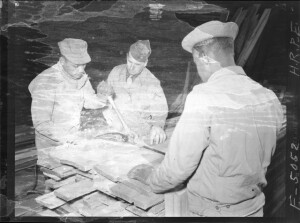 | 11/10/1943 | HANDLING OF DUNNAGE IN UNIT LOADS D Close-up view emphasizing tightness to which steel bands are drawn. Carelessness in placement of these bands and in drawing them sufficiently tight will result in a loose, shaky draft and will defy the desired purpose of maintaining a square, evenly piled load through every stage of further handling. | Lumber–Virginia–Newport News.; African American soldiers.; Straps–Virginia–Newport News.; Loading and unloading–Virginia–Newport News. | Shows three soldiers, two African American and one white, they are using a ratchet strap to secure a unit of lumber dunnage. | P0003/01-#F-5052 | ||||
| 3 | 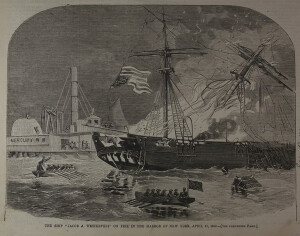 | SHORT DESCRIPTION: The print shows the ship Jacob A. Westervelt on fire in New York Harbor. The flames are burning the deck, the masts, and the stern, and one mast is in the process of falling. The American flag is upside down, and there are two rowboats and debris in the water around the ship. In the background on the left is the steam tug Mercury with a walking beam engine. NOTES: Image is from page 252 of the April 21, 1860 Harper’s Weekly. TEXT: “A BURNING SHIP We engrave on the following page a picture of the ship Jacob A. Westervelt, which was burned in New York Bay on the evening of Wednesday last. She was outward bound at the time. The following account of the disaster we condense from the Daily Times: ‘The fire originated in the between decks, aft, and was caused by the upsetting of a lamp. The carpenter had gone below, in company with a boy, for the purpose of procuring stores for the steerage passengers, eighteen in number, and while thus engaged the boy let the lamp fall; it broke, and set fire to the cotton stowed nearby, and in a few minutes the smoke was so dense as to defy the exertions of the men sent below to extinguish the flames. The Harbor Police steamboat Magnolia, with a squad of fifteen men on board, being near at hand, drawing shad-poles, immediately repaired to the ship and removed the crew and passengers, nearly all the cabin furniture, ship’s sails, some rigging, captain’s sextants and other instruments. The crews of Brazilian corvette Donna Isabel and the United States revenue cutter McLane were early on board, and in a very short time cut adrift and sent down the sails of the burning vessel, which were brought ashore by the police-boat. The steam-tugs Mercury and Samson and the steam ferry-boat Bedford, all of which have the Worthington pumps on board, were soon alongside, and numerous streams of water were thrown into the ship. The anchors of the burning vessel having been slipped she was towed ashore, between Bedlow’s and Gibbet Island, where she grounded head to the wind. This circumstance caused the fire to work forward slowly. In spite of every exertion the fire gained headway, and at 7 ½ pm the mizzen-mast fell over the stern; and at 10 ½ pm the fire had so increased that the mainmast went by the board, and the foremast fell soon afterward. At 12 o’clock the whole interior of the ship was a mass of fire, and all hopes of saving her hull had been abandoned. The vessel was scuttled where there is but sixteen feet of water at low tide. This was done at the request of one of the owners; but it proved a fatal mistake, as, had she been sunk at the point where she lay when the fire broke out, doubtless her hull would have been saved.’ Vessel and cargo are estimated at $235,000: supposed to be insured in Europe.” Other newspapers reported that it was the Sampson (not Samson) and the McLellan (not McLane), and the steam lighter Alpha was also there. The ship was built in 1849 by Jacob A. Westervelt and owned by H.L. Rich & Co. She was carrying corn, wheat, cotton, beef, bacon, lard, rice, hides, rosen, maize, rags, tea, and staves. The ship was named for and built by Jacob Aaron Westervelt, a shipbuilder and mayor of New York City. VESSEL INFORMATION - VESSEL NAME: JACOB A. WESTERVELT VESSEL DATES: 1849-1860 SHIP OWNERS: TAYLOR & MERRILL LINE | CL18095 | |||||||
| 4 | 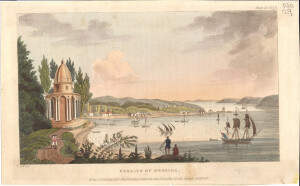 | SHORT DESCRIPTION: Hand-colored engraving titled the "Straits of Messina" published in Rudolph Ackermann's ' Repository of Arts, Literature, Commerce, Manufactures, Fashions, and Politics'. the image shows the church of Santa Maria Della Grotta at the left. Two men in Royal Marine uniforms stand on the road leading to the church gesturing out to the strait. In the foreground stands a fisherman casting a net, while a sits on the ground beside him. In the background is the busy Strait of Messina, which many small craft and a small British warship at the lower right. The strait is lined with low hills, on the left shore are houses and trees. NOTES: From: 'The Repository of Arts, Literature, Commerce, Manufactures, Fashions, and Politics,' 1st series, vol. 4, July–December 1810. It appears as plate 34 in the December edition, number 24, after page 350. The text accompanying the image reads (pages 350-352): PLATE 34.-DESCRIPTION OF THE STRAITS OF MESSINA. No one portion of the terraqueous globe has been so often celebrated, or so frequently been the scene of remarkable events, as the Straits of Messina, and the coasts which form them. They were first described by Homer, at once the greatest and most ancient of poets and historians. He has been followed by almost all the classic writers of Greece and Rome, as well as by the most celebrated among the moderns. But the subject, so far from being exhausted, is likely to prove a fertile source of materials for future authors. History and tradition, as well as philosophy and reason, concur in ascribing the formation of these straits to a tremendous convulsion of the earth, which rent the island of Sicily from the Continent. This dreadful earthquake most probably happened at the same remote period of time, when the subterraneous fires first found vent, and formed the burning mountains of Vesuvius and Etna; whilst the rocks of Scylla, and the whirlpool of Charybdis, owing to the same cause, composed a union of the most terrific objects in nature. Of all the ancient writers on these phenomena, Virgil alone describes the cause and the effect. "Hæc loca, vi quondam et vasta convulsa ruina, Tantum evi longinqua valet mutare vetustas! Dissiluisse ferunt, quum protenus utraque tellus Una foret: venit medio vi pontus et undis Hesperium Siculo latus abscidit, arvaque et urbes Littore diductas angusto interluit asta. Dextram Scylla latus, levam implacata Charybdis, Obsidet, atque imo barathri ter gurgite vastos Sorbit in abruptum fluctus, rursusque sub auras Eregit alteroos, et sidera verberat unda, At Scyllam coris cohibet spelunca latebris Ora exsertantem, et naves in saxa trabentem. EN. lib. iii. v. 414. " The dangers attending the navigation of these straits in ancient times, were not altogether poetic fictions. Before the invention of the compass, sailing was only attempted along shore; but all the skill and exertions of the best mariners were often of no avail in navigating this celebrated passage; for in avoiding the rocks of one coast, a more destructive whirlpool was ready to swallow up the vessel on the other. Hence arose the famous proverb, applied to persons who, to escape a threatened danger, rush into the opposite: Iucidit in Scyllam cupiens viture Charybdim. In the present day, however, these perils no longer exist. The rocks of Scylla rise out of smooth water (except at particular seasons), and Charybdis is only supposed to exist in a rippling tide, which is perceived off the point of the Faro of Messina. It is a subject worthy of investigation, to ascertain the causes which have rendered a passage through the straits at present so comparatively easy and safe. It is supposed, that, from the constant force and attrition of the currents, the channel has become wider, and, consequently, the stream less violent. But the true cause seems to be the frequent earthquakes which have changed the whole face of the country, and doubtless occasioned alterations to the very bottom of the sea. The last earthquake of 1783 was the most terrible on record: it overthrew most of the cities and towns on the coast of Calabria and on the east coast of Sicily, and buried about 60,000 of the inhabitants in the ruins. But although the passage through the straits is no longer dangerous, yet it very often happens that the transit cannot be effected without a leading wind; for there is always a strong current setting up the straits from the promontory of Scylla, which, in the narrows, is so very powerful as to require a stiff breeze to stem it. There are, besides, particular periods when the channel becomes violently agitated: these are at the equinoxes, and about mid-summer and mid-winter. For all these reasons, the transit from Italy is generally made at the widest part of the straits, namely, from Reggio to Messina, which is about seven miles across; or from the former to Taurementum, which is as many more. Thus is the preservation of Sicily owing to the shortness of the distance of the hostile coast; for it is this which makes the passage intricate, whilst the preparations of the enemy are constantly overlooked by those who are to oppose them. The annexed view was taken from a handsome church called Il Grutta [Santa Maria della Grotta], midway between the city of Messina and Il Torre del Faro, where the straits are narrowest, being there little better than a mile. and a half across. The Faro tower is situated on Cape Peloro (olim Pelorus), a long, low isthmus, which forms the north-west entrance. The opposite shore of Calabria is bold, high, and wooded; the whole resembles one of the great rivers of America. The north-east entrance is made by the famous rock of Scylla, distant from the Faro about two miles and a half. This rock, or promontory, is separated from the Continent by a deep ravine. It is surrounded by a number of smaller rocks; among which, in stormy weather, the sea makes a tremendous bellowing. The summit is crowned by the castle of Scylla, and the town of Scigleo is built on the sides. The English kept possession of this castle a long time in the midst of the enemy; at length he got his guns to bear on it from the adjacent heights, and we were compelled to abandon it. Both castle and town were much damaged by the earthquake of 1785, when the refluent sea swept away above 3000 people from the beach. If the island of Sicily constituted an integral part of the British dominions (and why it should not in the present times, no good reason can be adduced), it would not be difficult to prove, that it would become more valuable than all the foreign possessions of Great Britain, even including India, put together. Its natural productions of grain, oil, wine, and silk, might, by British industry and under British laws, be made to supply, not England only, but all Europe. Nature in vain has lavished all her bounties on this favoured country: they are abused or neglected by its wretched inhabitants, and still more wretched government. The Sicilians were never a free people, with the exception of the short, but brilliant independence of Syracuse and Agrigentum. They became successively the slaves of the Greeks, Carthaginians, Romans, Saracens, and Normans. In later times, the sovereignty of the island became the constant object of contention between the French and Spanish monarchies, who tyrannized over the country by turns. It is no wonder, therefore, that such a people should have lost every sentiment of freedom, become ignorant of its meaning, and utterly insensible of the energies it inspires. Sicily, with respect to Italy, is situated like Great Britain and France. If, then, we maintain possession of this fine island with a handful of troops, assisted by a flotilla and a few frigates, and defy the utmost efforts of the enemy to invade it, how absurd is it to entertain apprehensions for the invasion of the British Isles! [authored by] E. W. | CL27143 | |||||||
| 5 | 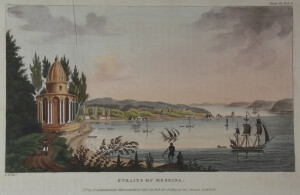 | SHORT DESCRIPTION: Hand-colored engraving titled the "Straits of Messina" published in Rudolph Ackermann's ' Repository of Arts, Literature, Commerce, Manufactures, Fashions, and Politics'. the image shows the church of Santa Maria Della Grotta at the left. Two men in Royal Marine uniforms stand on the road leading to the church gesturing out to the strait. In the foreground stands a fisherman casting a net, while a sits on the ground beside him. In the background is the busy Strait of Messina, which many small craft and a small British warship at the lower right. The strait is lined with low hills, on the left shore are houses and trees. NOTES: From: 'The Repository of Arts, Literature, Commerce, Manufactures, Fashions, and Politics,' 1st series, vol. 4, July–December 1810. It appears as plate 34 in the December edition, number 24, after page 350. The text accompanying the image reads (pages 350-352): PLATE 34.-DESCRIPTION OF THE STRAITS OF MESSINA. No one portion of the terraqueous globe has been so often celebrated, or so frequently been the scene of remarkable events, as the Straits of Messina, and the coasts which form them. They were first described by Homer, at once the greatest and most ancient of poets and historians. He has been followed by almost all the classic writers of Greece and Rome, as well as by the most celebrated among the moderns. But the subject, so far from being exhausted, is likely to prove a fertile source of materials for future authors. History and tradition, as well as philosophy and reason, concur in ascribing the formation of these straits to a tremendous convulsion of the earth, which rent the island of Sicily from the Continent. This dreadful earthquake most probably happened at the same remote period of time, when the subterraneous fires first found vent, and formed the burning mountains of Vesuvius and Etna; whilst the rocks of Scylla, and the whirlpool of Charybdis, owing to the same cause, composed a union of the most terrific objects in nature. Of all the ancient writers on these phenomena, Virgil alone describes the cause and the effect. "Hæc loca, vi quondam et vasta convulsa ruina, Tantum evi longinqua valet mutare vetustas! Dissiluisse ferunt, quum protenus utraque tellus Una foret: venit medio vi pontus et undis Hesperium Siculo latus abscidit, arvaque et urbes Littore diductas angusto interluit asta. Dextram Scylla latus, levam implacata Charybdis, Obsidet, atque imo barathri ter gurgite vastos Sorbit in abruptum fluctus, rursusque sub auras Eregit alteroos, et sidera verberat unda, At Scyllam coris cohibet spelunca latebris Ora exsertantem, et naves in saxa trabentem. EN. lib. iii. v. 414. " The dangers attending the navigation of these straits in ancient times, were not altogether poetic fictions. Before the invention of the compass, sailing was only attempted along shore; but all the skill and exertions of the best mariners were often of no avail in navigating this celebrated passage; for in avoiding the rocks of one coast, a more destructive whirlpool was ready to swallow up the vessel on the other. Hence arose the famous proverb, applied to persons who, to escape a threatened danger, rush into the opposite: Iucidit in Scyllam cupiens viture Charybdim. In the present day, however, these perils no longer exist. The rocks of Scylla rise out of smooth water (except at particular seasons), and Charybdis is only supposed to exist in a rippling tide, which is perceived off the point of the Faro of Messina. It is a subject worthy of investigation, to ascertain the causes which have rendered a passage through the straits at present so comparatively easy and safe. It is supposed, that, from the constant force and attrition of the currents, the channel has become wider, and, consequently, the stream less violent. But the true cause seems to be the frequent earthquakes which have changed the whole face of the country, and doubtless occasioned alterations to the very bottom of the sea. The last earthquake of 1783 was the most terrible on record: it overthrew most of the cities and towns on the coast of Calabria and on the east coast of Sicily, and buried about 60,000 of the inhabitants in the ruins. But although the passage through the straits is no longer dangerous, yet it very often happens that the transit cannot be effected without a leading wind; for there is always a strong current setting up the straits from the promontory of Scylla, which, in the narrows, is so very powerful as to require a stiff breeze to stem it. There are, besides, particular periods when the channel becomes violently agitated: these are at the equinoxes, and about mid-summer and mid-winter. For all these reasons, the transit from Italy is generally made at the widest part of the straits, namely, from Reggio to Messina, which is about seven miles across; or from the former to Taurementum, which is as many more. Thus is the preservation of Sicily owing to the shortness of the distance of the hostile coast; for it is this which makes the passage intricate, whilst the preparations of the enemy are constantly overlooked by those who are to oppose them. The annexed view was taken from a handsome church called Il Grutta [Santa Maria della Grotta], midway between the city of Messina and Il Torre del Faro, where the straits are narrowest, being there little better than a mile. and a half across. The Faro tower is situated on Cape Peloro (olim Pelorus), a long, low isthmus, which forms the north-west entrance. The opposite shore of Calabria is bold, high, and wooded; the whole resembles one of the great rivers of America. The north-east entrance is made by the famous rock of Scylla, distant from the Faro about two miles and a half. This rock, or promontory, is separated from the Continent by a deep ravine. It is surrounded by a number of smaller rocks; among which, in stormy weather, the sea makes a tremendous bellowing. The summit is crowned by the castle of Scylla, and the town of Scigleo is built on the sides. The English kept possession of this castle a long time in the midst of the enemy; at length he got his guns to bear on it from the adjacent heights, and we were compelled to abandon it. Both castle and town were much damaged by the earthquake of 1785, when the refluent sea swept away above 3000 people from the beach. If the island of Sicily constituted an integral part of the British dominions (and why it should not in the present times, no good reason can be adduced), it would not be difficult to prove, that it would become more valuable than all the foreign possessions of Great Britain, even including India, put together. Its natural productions of grain, oil, wine, and silk, might, by British industry and under British laws, be made to supply, not England only, but all Europe. Nature in vain has lavished all her bounties on this favoured country: they are abused or neglected by its wretched inhabitants, and still more wretched government. The Sicilians were never a free people, with the exception of the short, but brilliant independence of Syracuse and Agrigentum. They became successively the slaves of the Greeks, Carthaginians, Romans, Saracens, and Normans. In later times, the sovereignty of the island became the constant object of contention between the French and Spanish monarchies, who tyrannized over the country by turns. It is no wonder, therefore, that such a people should have lost every sentiment of freedom, become ignorant of its meaning, and utterly insensible of the energies it inspires. Sicily, with respect to Italy, is situated like Great Britain and France. If, then, we maintain possession of this fine island with a handful of troops, assisted by a flotilla and a few frigates, and defy the utmost efforts of the enemy to invade it, how absurd is it to entertain apprehensions for the invasion of the British Isles! [authored by] E. W. | CL16743 | |||||||
| 6 | 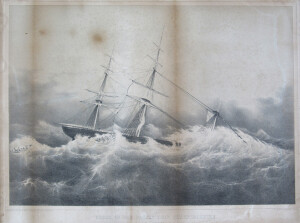 | NOTES: Boston Evening Transcript, January 18, 1854, page 1: WRECK OF SHIP STAFFORDSHIRE. Mr. Alden, the first officer of the Staffordshire, arrived in Boston on Monday evening, after a tedious ride by stage from Barrington, N. S., to Waterville, Me., and from the latter place by railroad. One of his feet and one hand were frost-bitten. He makes the following statement, which we copy from the Journal: "On the 23d day of December, in a tremendous gale of wind, twisted the rudder head, and secured it with chains as well as we could. Rigged a temporary tiller outside the ship, and with it managed to proceed pretty comfortably till Wednesday morning, at 4 o'clock, 28th, when in a gale, lost bowsprit, fore topmast, fore yard, and everything forward, leaving the foremast only standing. The wreck of spars, in floating astern, carried away the temporary rudder with it. Captain Richardson went aloft after daylight, to examine the truss, to see if it were practicable to rig another fore yard, and in coming down his foot slipped and he fell thirty-five feet, and struck on his back, badly injuring his ankle and receiving other serious injury. I immediately, with assistance, bore him to his state room, where he received the attention of Dr. Maloney, ship's surgeon. I then cleared the wreck, and made all snug as possible, and prepared to get a new fore yard aloft. The rudder was then perfectly useless: ship had no steerage way; worked all Wednesday night and succeeded in rigging another tiller in the cabin. At 3 o'clock, A. M., Thursday, 29th, the wind was from the eastward, heavy rain and blowing heavy. Run the ship all day Thursday on her course until 7 o'clock, evening, the barometer being very low–28.26. Made all snug for the night. At 8 P. M., came on a hurricane from west-northwest. At that time, judged ourselves 35 to 40 miles south of Seal Island. Consulted with Capt. Richardson, (who was confined to his berth,) who ordered the ship to be kept to the northward till 12 o'clock, and then to wear ship. It was then the second mate's watch on deck; who was ordered to call me at 12 o'clock. At ten minutes before 12, the second mate saw Seal Island Light, and immediately called me. I at once informed Capt. Richardson, who remarked that the current had set the ship in shore, and immediately ordered her to be wore round. This was done without loss of time, and when coming up on the southern tack the ship struck. It was then blowing a tremendous gale of wind, with snow, and very thick. The rigging and decks were covered with ice. The ship struck several times, and then went off into deep water. I immediately sounded the pumps, and found fourteen inches. Informed Capt. Richardson, and set all hands at the pumps; sounded pumps again in ten minutes, and found four feet of water in the hold. Got her head to the eastward, by the Captain's orders, and intended to beach her. In twenty minutes after, the wheel ropes parted, and she came up into the wind. Then all chances of saving the ship were lost, and measures were taken to save the lives. The fourth mate -Stephenson-previous to this, had left the ship with nine sailors and one woman passenger, in one of the quarter boats. The other quarter boat was swamped in launching, and was immediately cut away to launch the other boats. Got the small life-boat out, at that time the ship settling fast, and the sea coming in over both rails. Told them to launch this boat and save what they could, and nine or ten reached the shore in her, after having two planks stove while alongside the ship, before they could get clear. None of the mates were in this boat. The small boat was immediately put upon the starboard davits, and was instantaneously filled with people; in lowering her to the water she stove a hole in her, and she was hoisted up again. The long boat was then launched to the side, with very great difficulty, and thirteen men, including the second mate, jumped into her. While they were launching her, I went into the cabin for the third time, to endeavor to save Capt. Richardson, and told him that all hopes of saving the ship were gone, her lower hold being full, and six inches of water in the cabin, and offered to carry him in my arms and put him into the boat. He refused, saying the ship was so near shore that she would strike before she could go down. I then said, it is impossible, for she will sink in a very few minutes. The captain answered, Then if I am to be lost, God's will be done! which were the last words I heard. Finding it impossible to move him I then left the cabin, and found the long-boat was just leav-ing. I threw my big coat into her as she was leaving the ship. I went aft, and the boat came to under the stern, when I jumped from the taff-rail into the boat. We immediately got clear of the ship to prevent being drawn in when she should go down. We had only two small oars and no thole-pins. The wind was blowing very heavy, as before, with snow. Saw the ship and lights for about twenty minutes, and then all was darkness. We shipped a sea which filled the boat half full of water. Kept her off before the wind and sea till she was bailed out; then came up to the wind and remained till daylight, thinking to save lives, if any were still above water. Not a stroke was pulled till daylight, when nothing was in sight. We laid still another hour when we discovered land. We pulled for it, and landed in about ten hours after leaving the ship, all exhausted, and more or less frost-bitten. The other two boats had landed, about four hours previous. We were about nine miles from Barrington, on a small island called Sable Island. We were very kindly treated by the fishermen and their wives, and next day I proceeded to Barrington. Before leaving Barrington for Halifax, I went back to where we landed to see that the crew were provided for, and found that parts of the wreck had drifted ashore-the cabin work, houses on upper deck, &c. I left the crew and five passengers who were saved, as comfortable as circumstances would allow, and proceeded to Halifax, thence to St. John, where I missed the steamer about five hours. I then came on to Waterville by stage, and took the cars there for Boston. Mr. Alden gives the following as those saved as far as he knows: In Long Boat-mate, Joseph B. Alden; 2d do. A. T. Leet boy, John Cobbs; cook named Kel-ley; one passenger, O'Brien; and nine others. In Quarter Boat-4th mate, Mr. Stephenson: boy, Stephen G. Withington; woman passenger, Jane ; and seven others. In Life Boat-nine sailors. In Jolly Boat-3d mate, Mr. Morgan; sailor, Daniel O'Neil: and twelve others. In addition to the above we learn from Mr. Al-den that Capt. Richardson, previous to the ship's sinking, had been removed from his berth, and was placed on a mattress, on the cabin table. He did not consider himself very seriously injured, and up to the time of the disaster was in good spirits. In reply to a remark by the mate, he said: "We shall be in by new year's day." Mr. Alden says that his ankle was much dislocated and swollen-and was very sore; and he also complained of soreness in his back. Dr. Maloney, the ship's surgeon, was unremitting in his attentions to Capt. Richardson, as was also the stewardess. Both of these were lost. The Dr. was standing in the cabin door when Mr. Alden jumped from the sinking wreck into the boat. He belonged in Dublin, and was a skillful physician and surgeon, and a very excellent man. The passengers generally did not realize the danger they were in-but expected that the ship would be run on shore and they would escape. The women dressed themselves to land, putting on their best bonnets and other apparel. VESSEL INFORMATION - VESSEL NAME: STAFFORDSHIRE SERVICE DATES: 1851-1853 SHIPBUILDER: DONALD MCKAY BUILDER LOCATION: EAST BOSTON, MASSACHUSETTS DIMENSIONS: 1800 TONS VESSEL LAUNCHED: JUNE 17, 1851 SHIP OWNERS: ENOCH TRAIN & CO. TRADE ROUTE: BOSTON - LIVERPOOL FATE: Wrecked December 30th, 1853. VESSEL INFORMATION: Boston Daily Atlas, July 21, 1851. The New Clipper Packet Ship Staffordshire. Few enterprises appeared more discouraging at the commencement, that the attempt made by Mr. Train to organize a regular line of packets to sail between this port and Liverpool. The attempt had been twice made before, under the auspices of men of great wealth and undoubted enterprise, but owing to various causes, failed. When Mr. Train renewed the attempt, the prospect was far from encouraging. Many of our importers had been so long in the habit of receiving their merchandise by the way of New York, that they had imbibed [?] the idea that no packets which could be built here, would be able to compete successfully with those of the Empire City. Mr. Train had to dispel this idea; he had to demonstrate that a Boston line of packets equal, if not superior, to any belonging to New York, could be built here, before he could obtain the confidence of our importing houses. This required a large outlay of capital, and what was of equal importance, the exercise of much discretion in selecting a suitable mechanic to carry out his views. For this purpose he visited nearly all the ship-yards in New England, and thus, from actual observation, formed opinions of the merits of our various builders. Mr. Donald McKay had just finished the ship John R. Skiddy, built for a New York packet, under the superintendence of Captain William Skiddy, a gentleman of great expression, and much scientific attainments, and her appearance convinced Mr. Train that her builder was every way qualified to carry out his views. A contract was made with him, and the ship Joshua Bates, the pioneer of the line, as now organized, was built. But when ready for sea, trade was so dull that she was sent to Mobile to procure a freight. Her performance on this voyage, however, was highly satisfactory, and our Liverpool traders began to appreciate Mr. Train's efforts to merit [?] their co-operation in establishing his line. At the instance of Mr. Train, Mr. McKay removed from the Merrimac to East Boston, where he still continues, and has built every ship in the line. The Washington Irving, Anglo-Saxon, Ocean Monarch, Anglo-American, Parliament, and Daniel Webster, all magnificent vessels, were built in succession, and by their excellent sailing qualities, and the sound condition in which they brought their cargoes, convinced our mercantile community that they had fairly equalled if not surpassed the finest New York packets. The reputation of the line, in a few years was so firmly established, that notwithstanding the loss of the Anglo-Saxon and Ocean Monarch, public confidence never deserted it. The same master mind which organized the line soon filled its broken ranks, and has kept it ready at all times to meet the public wants. As trade increased, the several ships added to the lines were built in proportion to accommodate the trade; and now the last ship is the largest and most magnificent of them all; and is designed to be the swiftest packet ship in the Atlantic trade. She has three decks, and is 228 feet long on the keel, and 240 feet over all, from the chock over the bowsprit to the taffrail; has 41 feet extreme breadth of beam, 39 feet width at the planksheer, 29 feet depth from the upper deck, 20 inches dead rise at half-floor, 3 feet sheer, 1 foot rounding of sides, and will register about 1800 tons. She was originally designed to have only two decks, with a poop and topgallant-forecastle, but in building a third deck was made. This, of course, altered her outside appearance, by giving her great apparent depth bulwarks; and hence, to preserve the beauty of her original outline, required more than ordinary skill. She has the apparent bulwarks and monkey-rail of a two deck ship, and above these the bulwarks and monkey-rail of the upper deck, about 4½ feet high. But notwithstanding these additions, the harmony of her proportions has been carried out to perfection. Every line and moulding, from the planking of her sides to her monkey-rail, swell and taper with an ease and beauty that seem to defy comparison. Such has been the consummate skill displayed in the construction of her upper bulwarks and monkey-rail, that a casual observer would, no doubt, consider her incomplete in outline without them. Her water lines are slightly concave, and her ends sharp. The angle of her bow at the load displacement line is 18 degrees, and of her stern 20; and her greatest breadth of beam is nearly amidships. Her bow is at once bold and beautiful, easy and graceful in the sweep of its lines, and noble in its outline, as it swells into the fullness of her upper works. It is without trail or head boards, ornamented simply with gilded fleurs de lis around the hawse holes, and has an angelic witch upon the wing, robed in white vestments, for a head. Her name, in gilded letters, is carved into the lower monkey-rail, and gilded devices on the ends of her catheads also ornament her forward; but neat and tasteful as all these unquestionably are, we do not recollect to have seen a bow that could better dispense with ornaments. Broadside on, so truly defined is her sheer, not only along the mouldings of the rails, but in the minutest details, that the most fastidious nautical critic would find it difficult to suggest an improvement. Her stern is boldly elliptical, is formed from the line of the plank-sheer, and has every division of the side defined upon it. A beautiful arch of gilded carved work spans its lower division, and contains a manufacturing scene of Staffordshire, and opposite, a representation of Train & Co's store, on the end of Lewis wharf, with a lion's head on each side, and other devices below. Her name and port of hail follow the sweep of the arch, and are inside of it. Outside she is painted black, from the water to the rail, and inside white. Her deck is more spacious that that of any other packet ship in the trade, and is flush fore and aft. On the forecastle are two capstans, a gipsy winch, the windlass breaks, (the windlass is on the deck below,) bitts amidships, a companion-way on each side, which protects the entrance to the sailors' quarters, the fore hatchway, and the stay-bitts before the foremast. Abaft the foremast is a house 40 feet long by 16 wide, and 6½ high. Its forward and after parts cover stairways leading to the deck below, and its other divisions contain three galleys, coal and wood lockers, a stateroom for the cooks, &c. The galleys are laid with bricks, and lined with copper and tin, and their cooking arrangements are of the most approved patents. Abaft, and adjoining the house, is another protected staircase which leads to the deck below. Abaft this is the main hatchway; then the mainmast, with its topsail-sheet bitts and fife-rail, and abaft these another capstan, then a skylight 6½ feet long, 4½ wide, and 2 feet 3 inches high, with an angular top, having a mahogany frame, and brass rods, which protect the glass on every side. Farther aft is a house 10½ feet wide by 18 long, and 6½ high, which covers two staircases leading to the cabins below. It has 4 doors and 4 windows, and is finely ornamented with panelling, venetian blinds, &c. Abaft the mizzenmast is a skylight, like that already described, and 8½ feet abaft it a double skylight, uniform in height and width with those before it, but 13 feet fore and aft. The wheel-house has a clear passage between it and the bulwarks, and its after part is elliptical, to correspond with the outline of the stern. It is about 18 feet across, by 12 deep fore and aft, and has two doors, under an indented front, the top of which protects them. Like the house over the cabin staircase, is paneled, and otherwise ornamented. She has a new patent steering apparatus, consisting of a single screw and lever, the recent invention of Mr. Reed, and mahogany binnacles inlaid with brass. The wheel-house covers an entrance to the cabin on the starboard side, and the larboard side is fitted as signal lockers, and contains places for the log reel and glass, deep sea lead and line, hand leads, &c. In addition to those already noticed, she has four bitts, ranged along the deck abaft the main rigging, on each side, and lever winches on each side abaft the fore and main rigging. Her main rail inside is covered with yellow metal. Her gangway boards are of polished mahogany, ornamented with carving, and her bulwarks and house are painted pure white. The sailors' quarters are below forward, are fitted up in superior style, and bulk-headed clear of the deck abaft them. Then follows a clear space for the wind-lass and working the chains; also a large port on each side, suitable for taking in or discharging cargo through, or for the accommodation of her guns, for she has two nine pounders on this deck. Her chain lockers are below, alongside of the foremast. The deck abaft to the main hatchway, has three longitudinal divisions. On each side are double water closets, abaft these sixteen state rooms, eight on each side, with two berths in each; and outside of the rooms spacious gangways. In the centre there are a sail room, coal locker, and an ice house, all embraced in the midship division of the deck. The three divisions are complete in one, and have doors forward and aft. Opposite the main hatchway, on each side, she has two large cargo ports, similar to those forward, and all the ports have iron gratings, so that when the ports outside are open for ventilation, no one can fall through them. Close by the mainmast are her hold pumps, which are of a new patent, said to be superior to any which has yet been invented. Abaft the mainmast, the entire space is devoted to cabins, state rooms, and their details. On the starboard side is a state room for the third and fourth mates, and on the opposite side a similar state room for the boatswain and carpenter; also water closets on each side, for the use of the second cabin passengers. Abaft this is a cabin containing two state rooms on each side; and abaft it another cabin with four double state rooms, having four berths in each room. This cabin communicates with the deck above by a staircase, which opens in the fore part of the house on deck, already noticed, and in the after part of which is the main entrance to the great cabin. For the admission of light below, there is a skylight, immediately under that above, in the deck of the second cabin. Abaft this is another apartment, which forms a vestibule to the great cabin, and contains the pantry and its store room in the larboard side, a state room for the steward amidships, state rooms for the chief and second mates, a mess room for the officers, a water closet, and amidships, around the mizzenmast, another store room. The great cabin is entered by a door on each side, and contains twelve spacious state-rooms, a water-closet aft, and a stair case on the starboard side, which leads into the wheel-house. It is finished and furnished in a style of elegance that must be seen to be appreciated, for no description which we can give of it can do it anything like justice. Its frame work is of mahogany. The panels are crowned with gothic arches, and are of pure enamelled white, lined along the margins with gold, and flowered with gold in the centres. They are raised, or rather their outlines are indented and form rosewood grooves, outside of which ate the pilasters. These last are also lined with gilding, and ornamented with gilded carved work in the middle. Their capitals are richly carved and gilded, and their pedestals are enamelled in imitation of dark veined marble. The forward partition amidships displays three mirrors, arched like the panels; and aft there is a splendid sofa, close to the stern. The rudder casing is finished in the same splendid style as the sides of the cabin. the beams are fringed with gilding, and the cornices are of papier maché, ornamented with roses, blooming in gold. The ceiling is white, and the lofty sky-lights and stern-lights are at once ornamental as well as useful. The carpets, table, settees, and other furniture, are of the richest material suitable for sea service, and are elegantly arranged. A more beautiful or convenient cabin no reasonable being would desire. Its state-rooms are spacious, have deck and side lights, perforated ventilators between the beams, and are furnished in the same style of elegance as the cabin, with the addition of all the little details, necessary for the personal comfort of their occupants. Every room is a miniature cabin in itself. The captain's room is on the starboard side, close to the staircase, and before it that of his chief officer, who in turn is close to the second officer, so that all may pass to and from their state-rooms without the slightest interference with the accommodations of the passengers. The cabins were designed and finished by Mr. Manson; and her ornamental carving by Messrs. Gleason & Sons. The lower deck is clear fore and aft, and is admirably deigned either for the accommodation of steerage passengers, or the stowage of cargo. the lights in its sides, are so designed, that a constant current of air passes through them, without the disagreable accompaniment of water. When water strikes these lights, a valve close and shuts it out, and when it recedes the action of the air opens them again. In addition to these, the spacious hatchways, except those used for staircase, are skylights, and throw a flood of light below. The passengers of every class have their distinct accommodations, clearly defined in every detail, even to the stairways by which they pass to and from their several locations, so that misunderstanding is almost impossible. her accommodations throughout, are unsurpassed for convenience or comfort by any vessel of her class that we have ever seen. Her furniture, such as cables, anchors, boats, &c., is of the first quality, made in every particular to meet the fullest requirement if the underwriters. In her hold, and up to the main deck, she has two circular iron tanks, each capable of holding 6000 gallons of water. Nothing in her outfits, deemed necessary to render her a perfect ship has been omitted. The style of her construction is every way worthy the beauty of her model. Her frame is mostly of white oak, strongly copper and iron fastened, and all her knees, hooks and pointers in the hold, are also of oak. Her keel is of rock maple in two depths, sided 16 and moulded 38 inches; floor timbers in the throats sided from 12 to 13, and moulded 18 inches, and bolted with 1¼ inch copper through the keel. She has three depths of midship keelsons, sided 15 inches and moulded 5 feet, making her back bone, from the upper part of the keelson to the base of the keel, 9 feet 8 inches through, bolted in the most substantial style. She has also sister keelsons 15 inches square, bolted diagonally through every navel timber into the keel, and horizontally through the lower depth of the midship keelson. The ceiling on the floor is 4½ inches thick; on the bilge there are three strakes of 14 by 12; then three of 12 by 10, then six of 14 by 8, and then a clamp of 15 by 14 inches for her hold beams -- for she has 10 of these, bound together with oak lodging knees, which meet and scarph in every berth, and with the hooks fore and aft, and thus form a belt of oak around her inside. The ceiling above is 7 inches thick, but over the beams outside of the ceiling is another strake of 12 by 5 inches. All the thick work, in fact nearly all her ceiling is scarphed and square fastened. She has 5 hooks and pointers forward, and 4 aft, and some of these are 40 feet long on each side, and not less than 12 inches square. Her hold or orlop beams are also supported by stanchions amidships, and all the stanchions under the lower deck are kneed above and below. Her lower deck beams are about 16 inches square amidships, the main deck beams 12 by 16, and those under the upper deck 10 by 6. The hold stanchions are 10 by 12 inches, and the stanchions under the decks above are of oak, turned, secured with iron bolts through their centres. The hanging knees in the hold are sided 12 inches and moulded about 2 feet in the angles, and have from 16 to 18 bolts in each. The lower deck waterways are 15 inches square, the strake over them 10 by 16, and the lock strake outside of them 12 by 14, all bolted vertically and horizontally, and the ceiling above varies from 6 to 8 inches in thickness. The hanging and lodging knees in this deck are of hacmatack, moulded and sided like those below. Her bow and stern are also spanned by massive hooks, which extend well along the sides. The main deck waterways are 12 by 14 inches, and under the upper deck beams are two clamps, one of 6 inches, and one of 5 inches, and the ceiling below in proportion. The upper deck waterways, the covering board and main rail, vary from 8 to 5 inches in thickness. her lower and main deck planking is of hard pine 3½ inches thick, and the upper deck of white pine 3 inches thick. Her stem, apron, stern post, false post, and dead wood, are very stout, and bolted in the first style of workmanship. Her garboards are 7 inches thick, the strake outside of them 6 inches, the 3d strake 5, and the planking outside 4½ inches. Her wales are 6 by 7 inches, and she is planked up flush to the main planksheer. The garboards are let into the keel -- are alternately bolted through it and each other, and square fastened through the timbers. Her butt and bilge bolts, and treenails, are all of the first quality, driven with great care and strength. In soundness of materials, strength of construction, and excellence of finish, she is all a ship ought to be. In the proportion of her spars she is considered, by many of our best seamen, to be more perfect than any clipper ship which has yet been built in this vicinity. To the eye she is certainly very neat aloft; nothing seems too heavy, or out of proportion. Her masts rake alike, viz.: 1¼ inch to the foot, and the fore and main are fished in the sides, and hooped, but the mizzen mast is a single spar. Her lower masts are, commencing with the fore, 82, 88 and 78 feet long; topmasts, 46, 48 and 40; topgallant masts 25, 26 and 22; royal masts 17, 18 and 14; and poles 8, 10 and 17 feet. Her head yards are 70, 55, 41 and 32 feet square; main yard and upwards 78, 62, 48 and 35 feet; cross-jack yard and upwards 56, 44, 32 and 24 feet. The bowsprit is 26 feet outboard, jib-booms in one spar, divided at 16 and 13 feet outside of the cap, for the standing and flying jib, with 5 feet end. The spanker boom is 58 feet, gaff 45, and main spencer gaff 24 feet. In the style of her rig she is nearly the same as the clipper ship Challenge. Her fore stays set up inboard, clear of the bowsprit, and her main topmast stays in the fore top, Her tops are boarded close to the eyes of the rigging, and look both snug and substantial. Her rigging is fitted in the usual style, but after she has performed a voyage or two, we have no doubt Capt. Brown will have it made to look as neat as that of his last ship, the Parliament. Messrs. Carnes & Chessman, who have rigged all Mr. Train's ships, rigged her. Of her blocks and sheaving we cannot speak too highly; they are such as sailors love -- easy and strong. They were turned out of hands by one of our best mechanics, Mr. Thomas J. Shelton. Her yards are black, the lower masts white, and her royal mastheads are crewed with gilded balls and spires, which make a most beautiful finish aloft. Mr. McKay, who built her, also designed her spars, and every other scientific detail about her within his province; and he is sanguine that she will outsail any vessel he has yet built. Capt. Albert H. Brown, who commands her, superintended her outfits himself, and all who know him professionally are aware that he is every way qualified to make her do her best. By the force of his own character, he has raised himself, step by step, from before the mast to his present position -- a position alike honorable to himself and the line of packets to which he belongs, and of which he is the senior captain. He is uniformly beloved by his seamen, and is without a rival in popularity with passengers. In a word, he is a gentleman and a sailor. A Messrs. Train & Co., her owners, are about having a line of propellers built, it is probable that she will be the last sailing ship of their Liverpool line. She is certainly the most splendid of all their ships; and we have no doubt will soon prove herself in speed what she unquestionably is in beauty and strength -- the Queen clipper packet ship of the Atlantic. | CL10316 |
Created 2026 by Don Barker, CBMM volunteer, for the Chesapeake Shipbuilding Project. shipbuilding@sailingworkboats.es